

नागेन्द्रहाराय त्रिलोचनाय भस्माङ्गरागाय महेश्वराय।
नित्याय शुद्धाय दिगम्बराय तस्मै नकाराय नमः शिवाय॥
(Salutations to Lord Shiva, who is adorned with the king of serpents as His garland, who has three eyes, whose body is smeared with sacred ash, who is the supreme ruler of the universe, who is eternal and pure, who is clad in the directions as His garment, and who is symbolized by the syllable 'Na' in the holy Panchakshara mantra. )
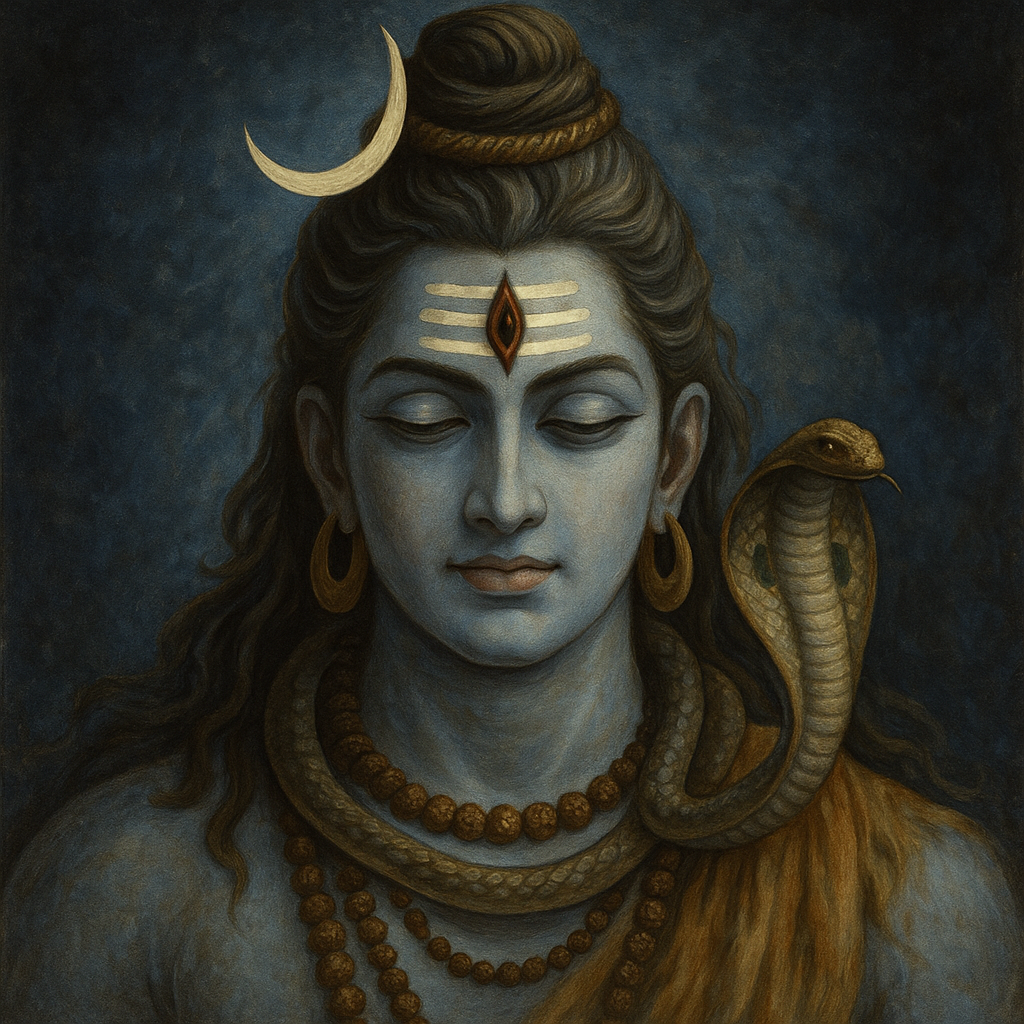
Lord Shiva, the Mahadeva, is often described in scriptures and chants as the one who wears a serpent around His neck—a sight that holds deep spiritual meaning and cosmic significance. The snake, known as Vasuki, is not just a companion but a symbol of fearlessness, transformation, and divine power.
In Hindu dharma, snakes (nāgas) are seen as sacred beings associated with mystical energy, protection, and the cycle of life and death. Their presence on Lord Shiva reflects His mastery over time, death, and illusion (Maya). Wearing the snake shows that Mahadev has conquered all fears, and lives in perfect alignment with the universal truth.
This article explores the spiritual symbolism of snakes in Shiva’s form, the deeper meaning behind Vasuki’s presence, and why snakes are revered in Hinduism. Through these divine associations, we discover how Shiva teaches us to transcend fear, embrace transformation, and walk the path of inner awakening.
Why Lord Shiva Wears a Snake: The Deeper Spiritual Symbolism
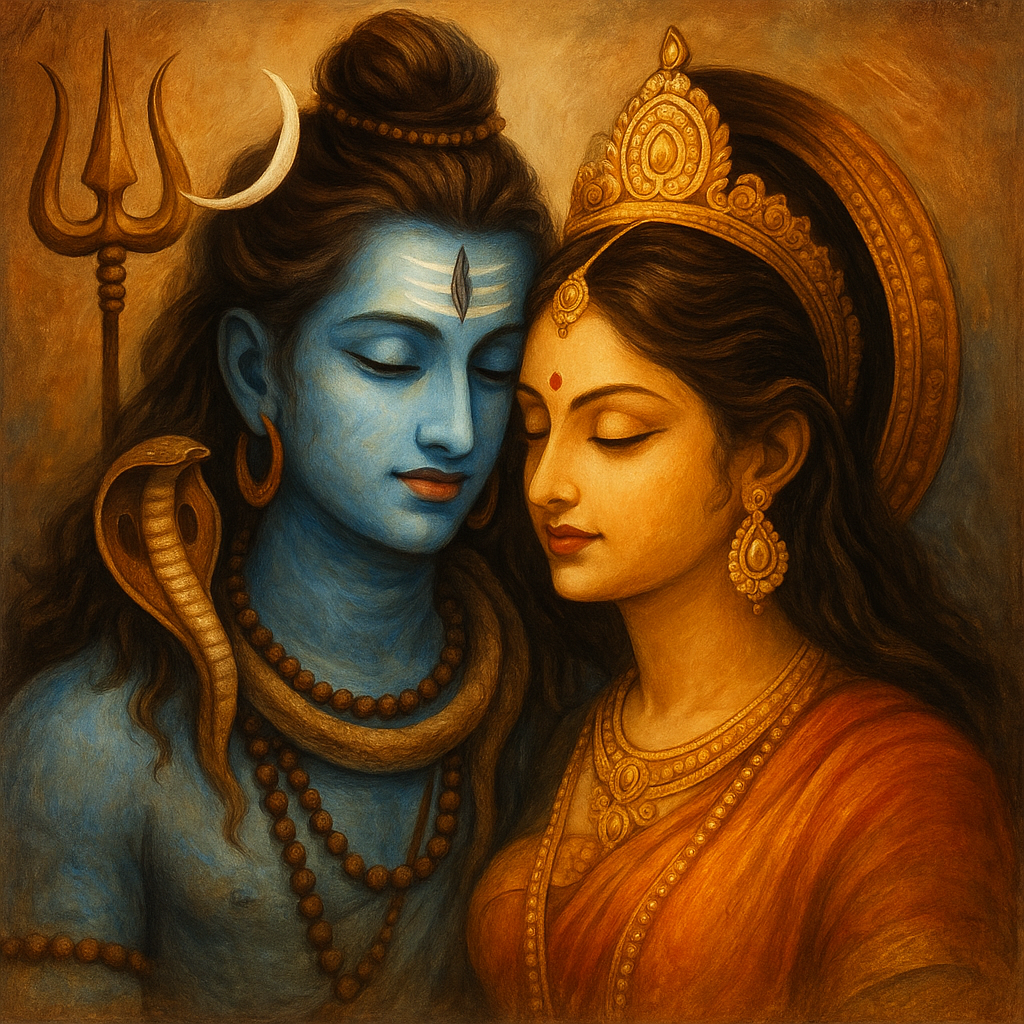
Lord Shiva, the Mahadeva, is revered as the fearless ascetic who wears a living serpent around His neck, a divine image that reflects profound spiritual truths and cosmic mastery. The serpent coiled around His throat is Vasuki, the king of nāgas, who rests peacefully upon Shiva’s body like a garland, radiating both power and surrender.
In Sanatan Dharma, snakes (nāgas) are not feared but honoured as sacred beings. They are deeply connected to mystical energy (kundalini), the cycle of birth and death, and the forces of transformation and protection. When Shiva wears Vasuki, it symbolizes His complete control over death, time, and fear—showing that He is untouched by worldly illusion (Maya) and firmly established in the eternal truth.
The snake also represents the dormant spiritual energy that lies coiled at the base of the spine in every being. By placing it near His throat, the Vishuddha Chakra, the center of truth and expression; Shiva demonstrates the awakened state of consciousness, where energy flows freely without fear or suppression.
Through this sacred imagery, we understand that Lord Shiva is the supreme yogi, whose calm embrace of even the most feared creature teaches us to face our inner darkness, transform ignorance into wisdom, and transcend all dualities.
In the next sections, we’ll explore the stories behind Vasuki’s devotion to Shiva, the symbolism of snakes in Sanatan Dharma, and how this divine connection holds powerful lessons for seekers on the spiritual path.
The Dual Symbolism of Snakes: Danger and Divinity in Lord Shiva’s Form
Building upon the deep spiritual meaning behind Lord Shiva wearing a snake, we now explore the duality that serpents represent; danger and divinity, fear and transcendence.
In the physical world, snakes evoke fear due to their venom and silent, unpredictable movements. Across various cultures, they are seen as symbols of death, danger, and karmic retribution. But in Sanatan Dharma, this fear is not ignored, it is transformed. Through the image of Mahadev adorned with Vasuki, the king of serpents, the snake evolves from a feared creature into a symbol of cosmic energy, spiritual awakening, and inner mastery.
Lord Shiva, the supreme ascetic and knower of ultimate truth, embraces what the world fears. By placing Vasuki near His throat, beside the blue mark left by the Halahala poison. Shiva reveals fearlessness and perfect self-control. He shows us that when faced with awareness, even what is feared becomes sacred.
The serpent’s coiled form around Shiva’s neck represents Kaal (time). Eternal, cyclical, and unstoppable. Yet Shiva is Mahakaal, the One beyond time, who wears time itself as an ornament. This signifies His sovereignty over life, death, creation, and destruction. The snake becomes a powerful metaphor for the transcendence of all dualities: life and death, fear and wisdom, destruction and rebirth.
In yogic and tantric traditions, the snake also symbolizes Kundalini Shakti, the coiled spiritual energy lying dormant at the base of the spine. When awakened, it rises through the chakras to merge with Shiva consciousness at the crown. Vasuki around Shiva’s neck reflects this awakened energy; conscious, balanced, and fully integrated.
In Shiva’s presence, the dangerous becomes divine, the feared becomes revered, and poison becomes a source of protection. This is not mere symbolism; it’s a spiritual teaching. Liberation doesn’t come from avoidance, but from facing fear, embracing transformation, and discovering the divine essence hidden in the darkest corners of existence.
Thus, through Lord Shiva’s form, the serpent becomes a sacred teacher, a protector, a guide, and a symbol of the eternal cycle of creation, dissolution, and awakening. In the embrace of the Supreme, all fear dissolves, and what once bound the soul becomes the very force that sets it free.
Snakes as Protectors and Stabilizers in Hinduism
Having seen how Lord Shiva’s snake Vasuki symbolizes transformation and transcendence, we now look deeper into the broader role of serpents in Sanatan Dharma, not as objects of fear, but as divine beings entrusted with cosmic protection and spiritual balance.
In scriptures like the Bhagavata Purana and the Mahabharata, Nāgas (serpents) are not portrayed as merely earthly creatures. They are described as guardians of dharma, upholders of stability, and channels of divine energy that maintain order in the universe.
Among them, Shesha Naga holds a place of supreme reverence. The eldest son of Kadru and Sage Kashyapa, Shesha became disillusioned by the unrighteous behavior of his serpent kin. Choosing the path of tapasya and detachment, he performed intense penance. Impressed by his discipline, Lord Brahma blessed him with the divine role of stabilizing Bhumi (Mother Earth).
Shesha now resides in Patala Loka, holding the Earth steady upon his vast, coiled hoods. Despite the ever-changing cosmic currents, Shesha remains immersed in yogic meditation, radiating calmness, sattva, and balance:
शेषः सदा योगनिमग्नदेहः संसारतापं समवेद्य धीरः।
उन्नद्धदोषानवमत्य लोके नित्यम् परं सत्त्वमुपैति शान्तः॥
'Shesha, ever immersed in deep yogic meditation, remains calm despite perceiving the sufferings of the world. Free of pride, he upholds the highest sattvic state and cosmic steadiness.'
– Bhagavata Purana
Similarly, Vasuki, who adorns Lord Shiva’s blue throat (Neelkanth), plays a powerful symbolic role. He represents surrender to the supreme, resting peacefully near the very poison (Halahala) that could have destroyed creation. His presence reveals a powerful truth: when negativity is surrendered to divinity, it loses its power to harm and instead becomes an instrument of balance.
Vasuki is not only Shiva’s companion but also a central figure in divine events such as the Samudra Manthan (Churning of the Ocean). In this cosmic act, Vasuki served as the churning rope, enabling both poison and nectar to be drawn from the ocean, representing the duality of life and the role of effort and endurance in spiritual growth.
वासुकिर्नाम नागेन्द्रो नीलकण्ठप्रियंवदः।
सर्पराजो महातेजा धर्मरक्षक उच्यते॥
'Vasuki, the king of serpents, dear to the blue-throated one, is a great protector of dharma and a being of immense divine radiance.'
Together, Shesha and Vasuki illustrate the sacred power of snakes in Hindu understanding. Shesha upholds the Earth, grounding physical existence, while Vasuki upholds the spiritual order, aligning with Lord Shiva’s fearless stillness amidst chaos. They are reminders that what appears fearsome can become sacred when aligned with dharma.
Their presence in the scriptures invites us to reflect on the hidden forces that support life, often invisible yet vital forces like stability, surrender, patience, and spiritual focus. Just as Lord Shiva wears Vasuki, we too are called to embrace the serpent of wisdom. The inner awareness that remains calm, coiled, and powerful in the face of life’s turbulence.
Worship of Serpents in Hinduism: A Sacred Path to Shiva and Self-Realization
Following the spiritual symbolism of Shesha and Vasuki as protectors and stabilizers of the cosmic order, we now arrive at how serpent worship evolved into a sacred spiritual practice in Hinduism, rooted in reverence, not fear.
In the Vedas and Puranas, serpents are described not as dangerous creatures, but as beings of deep penance (tapasya), firmly aligned with the divine will. Nāgas and Nāginis are seen as powerful energies residing at the threshold between the material and spiritual realms, embodying wisdom, protection, and transformation. This reverence forms the basis for snake worship in Sanatan Dharma.
One of the most sacred celebrations dedicated to them is Nag Panchami. A festival where devotees offer milk, flowers, and prayers to snake idols, sacred anthills, or live serpents in temples. This act is symbolic gratitude for the serpent energies that silently guard households, fertility, health, and family harmony. It is also an acknowledgement of their spiritual presence as guardians of thresholds, between death and rebirth, ignorance and awakening.
The connection between serpents and Lord Shiva deepens this tradition. Just as Shiva wears Vasuki, symbolizing the taming of fear, ego, and desire, devotees honour snakes as reminders of inner transformation. The act of worship is not merely ritualistic, it is a devotional alignment with Shiva’s own message: liberation comes through transcendence.
Vedic astrology also speaks of Sarpa Dosha or Naga Dosha, karmic patterns believed to result from past-life offenses against serpents or serpent energies. These can manifest as obstacles in marriage, fertility, or spiritual progress. To overcome them, rituals like Sarpa Dosha Nivaran Puja are performed, offering prayers to Nāga Devatas and Lord Shiva to purify karma, restore balance, and awaken higher consciousness.
Through such practices, serpent worship becomes a path of awareness. Inviting devotees to see beyond fear and form, to recognize the formless, divine energy present in all life. As protectors, stabilizers, and spiritual symbols, serpents reflect the very essence of Shiva's teachings: face what you fear, embrace what you resist, and you will find wisdom, peace, and ultimate liberation.
In honouring the serpent, we honour the coiled kundalini within us, waiting to rise, awaken, and merge into the infinite.
The Divine Origin of Snakes in Hindu Scriptures
Continuing from the sacred symbolism and worship of serpents, the origin of snakes in Hinduism is deeply rooted in ancient scriptures like the Mahabharata and the Puranas, where they are portrayed not as mere creatures, but as divine beings with cosmic responsibilities.
According to the texts, snakes were born from Kadru, one of the thirteen daughters of Daksha Prajapati, and Sage Kashyapa, a revered rishi. Through her intense tapasya, Kadru gave birth to a thousand radiant serpents, each carrying mystical powers and elemental energies vital to the cosmic fabric.
Among these, two stood out for their spiritual greatness. Shesha and Vasuki.
Shesha, the eldest, was disheartened by his siblings’ arrogance and chose the path of renunciation and dharma. Retreating to the Himalayas, he performed deep tapasya, after which Lord Brahma granted him the eternal duty of supporting Bhumi (Earth) on his mighty hoods. Shesha represents stability, equilibrium, and the sattvic force that holds the world steady amid chaos.
Vasuki, the younger but equally virtuous serpent, chose a life of divine service and cosmic interaction. Honoured as the snake around Lord Shiva’s neck, he embodies surrender, transformation, and fearless devotion. During the Samudra Manthan, Vasuki offered himself as the churning rope between devas and asuras, enduring great pain to manifest both amrita (nectar) and halahala (poison)—the latter consumed by Shiva, earning Him the title Neelkantha.
'वासुकिर्नाम नागेन्द्रो नीलकण्ठप्रियंवदः।
सर्पराजो महातेजा धर्मरक्षक उच्यते॥'
'Vasuki, the king of serpents, dear to the blue-throated one, is a radiant protector of dharma.'
These stories affirm that Nāgas are not symbols of darkness but divine forces of dharma and balance. While Shesha holds the physical Earth, Vasuki aligns with spiritual transformation; both serving as pillars of cosmic harmony.
Their origin teaches us that spiritual elevation is not defined by birth, but by choice, choosing service over self-interest, dharma over ego, and truth over illusion.
The Birth of Serpents: Kadru and Sage Kashyapa
The Mahabharata recounts that Kadru, desiring to populate the world with mighty beings, gave birth to a thousand serpents of great strength. These serpents, however, were not uniform in their nature. While the eldest, Shesha, and his younger brother Vasuki were virtuous and noble, many others developed tendencies of cruelty, greed, and destruction. Their unrighteous actions disrupted harmony in the world, spreading fear and chaos among other beings.
This dichotomy among the serpents highlights a recurring theme in Hindu philosophy: the coexistence of divine and destructive energies within creation. Just as fire can purify or burn, serpents represent both karmic retribution and spiritual protection.
While the other serpents symbolized uncontrolled desires, ego, and imbalance, Shesha and Vasuki chose the path of dharma, restraint, and devotion. Their decision to rise above their lineage’s tendencies and serve the divine illustrates that free will, discipline, and spiritual intention can transform even the most turbulent energies into forces of universal good.
Shesha: The Eternal Stabilizer
Disturbed by the misdeeds of his siblings, Shesha, the eldest and wisest among the serpent brothers, chose the path of renunciation and inner discipline. Disillusioned by their aggression and disregard for dharma, Shesha withdrew from worldly entanglements and turned inward. He undertook intense tapasya (penance) at sacred sites like Gandhamadhana, Badrikashrama, and the Himalayas, seeking freedom not only from external distractions but from the ego itself.
His unwavering devotion and yogic stillness are immortalized in the Bhagavata Purana, which glorifies Shesha's serene detachment and subtle perception of the world’s sorrow:
शेषः सदा योगनिमग्नदेहः संसारतापं समवेद्य धीरः।
उन्नद्धदोषानवमत्य लोके नित्यम् परं सत्वमुपैति शान्तः॥
“Shesha, immersed in eternal yoga and meditative states, perceives the suffering of the world and, free from arrogance, remains calm and in supreme truth to serve the cosmos.”
Moved by Shesha’s purity, humility, and unshakable equanimity, Lord Brahma appeared before him and offered him a boon. Shesha’s response reflected the ideal of spiritual selflessness, he asked for the opportunity to serve the cosmic order, rather than enjoy any personal gain. In response, Brahma entrusted him with the sacred task of supporting Bhumi Devi (Mother Earth) on his hoods, stabilizing her against the turmoil of karmic forces and time.
As the eternal stabilizer, Shesha continues to uphold the Earth in a spirit of quiet dedication. His immense strength is balanced by his inner stillness. An emblem of sattva (purity) and spiritual clarity. In this way, Shesha becomes a living symbol of dharma, illustrating that true strength arises not from domination, but from alignment with divine purpose.
His legacy also extends to Lord Vishnu, who is said to rest upon Shesha in the cosmic ocean of Kshira Sagara. This further elevates Shesha’s role from that of a mythological serpent to a pillar of the universe, supporting both the Earth and the Divine.
Shesha’s story teaches that even in a world filled with chaos and conflict, one can choose the path of wisdom, service, and inner peace. His presence beneath the Earth is a constant, unseen force, a reminder that those who dedicate themselves to dharma may not always be visible, but their contribution is immeasurable and eternal.
Vasuki: The Loyal Servant of Lord Shiva
Vasuki, the second eldest serpent born to Kadru and Sage Kashyapa, chose a path distinct from his brother Shesha, yet equally noble. While Shesha turned inward through penance and meditation, Vasuki directed his devotion outward offering himself in active service to Lord Shiva, the Supreme Consciousness. Coiled gracefully around Shiva’s neck, Vasuki is not merely an ornament, but a living symbol of surrender, humility, and unwavering loyalty.
By resting near Shiva’s blue throat, the site of the halahala poison absorbed during the churning of the cosmic ocean. Vasuki reflects his fearlessness and complete trust in divine will. His proximity to one of the most volatile aspects of the universe speaks volumes of his spiritual stability and inner strength. In Shiva’s divine stillness, Vasuki finds his place, not through pride, but through devotion and absolute surrender.
Vasuki’s most renowned act of selflessness is recorded in the story of the Samudra Manthan (Churning of the Milky Ocean), a pivotal cosmic event described in the Bhagavata Purana, Vishnu Purana, and other sacred texts. When the Devas (gods) and Asuras (demons) sought the nectar of immortality (amrita), they used Mount Mandara as the churning rod, but no ordinary rope could bind such a task. Vasuki offered himself as the churning rope, allowing his massive body to be pulled from both ends, by Devas on one side and Asuras on the other.
As the mountain rotated and churned the depths of the Kshira Sagara (Ocean of Milk), Vasuki endured extreme physical torment. From his mouth, halahala, the deadliest poison, emerged, so potent it threatened to destroy all of creation. Seeing the devastation it could cause, Lord Shiva stepped forward, consuming the poison to protect the cosmos, while Vasuki remained wrapped around Him, a testimony to his courage and dedication.
This act of voluntary suffering for the greater good reveals Vasuki’s true spiritual stature. He did not retreat in fear; he fulfilled his dharma with grace. His story teaches that devotion is not passive. It is active service, even when it requires sacrifice, pain, or standing firm amid adversity.
Even today, Vasuki’s presence around Shiva’s neck is rich with symbolism. It represents the mastery of fear and desire, the willingness to carry karmic burden for others, and the elevation of ego into selfless devotion. For devotees, Vasuki stands as a guardian, a symbol of protection, and a reminder of the transformative power of complete surrender to the divine.
In Vasuki, we see a reflection of the Bhakta’s ideal, not one who seeks reward, but one who offers himself fully to the Lord, becoming a conduit of divine work in the universe. His enduring place in the iconography of Lord Shiva ensures that his legacy as a loyal servant of the Supreme remains immortal, inspiring generations to walk the path of service, surrender, and inner strength.
The Dual Legacy of Serpents
While Shesha and Vasuki symbolize stability, wisdom, and unwavering devotion, their serpent siblings represent the uncontrolled forces of desire, deception, and destruction. This contrast forms the heart of the dual legacy of serpents in Hindu mythology, where the same lineage produces both protectors of cosmic dharma and agents of disorder. It is a powerful metaphor for the human condition: that potential for both divine elevation and karmic downfall lies within every being.
The serpent archetype in Hinduism is layered with paradox. Serpents are feared for their venom and unpredictability, yet revered for their power, endurance, and spiritual symbolism. The misdeeds of many among the thousand serpent offspring, marked by envy, wrath, and deceit, are cautionary tales of how adharma (unrighteousness) corrupts the soul and disturbs cosmic harmony. These serpents, bound by karmic consequences, became symbols of latent negativity that must be transformed or transcended.
In contrast, the luminous paths of Shesha and Vasuki affirm that free will, devotion, and righteous action (dharma) can elevate even those born into turbulent circumstances. Their lives became a testament to the fact that divinity is not inherited, it is chosen. By embracing sacrifice, surrender, and service, they aligned themselves with the will of the divine, ultimately becoming pillars of cosmic balance.
This dual legacy reflects the greater Vedantic truth that creation is held in balance by opposing forces, light and shadow, chaos and order, ego and surrender. The wise do not seek to destroy one side, but to transform and harmonize it. Shiva’s embrace of Vasuki and Vishnu’s repose upon Shesha reflect this principle: the divine does not reject the serpent. It redeems it, tames it, and places it at the centre of the cosmic narrative.
By understanding the origins of serpents and their symbolic roles in scripture, we gain a deeper reverence for their presence, not as mere creatures of fear, but as instruments of divine will, as guardians of sacred knowledge, and as mirrors of our inner struggle between dharma and desire.
Through the lives of Shesha and Vasuki, we are reminded that even the darkest forces can be sanctified through devotion, awareness, and alignment with truth. In this way, the serpent becomes the seeker, the one who sheds its lower nature again and again to inch closer to the eternal light of Lord Shiva.
Who is Vasuki? The Snake Around Lord Shiva’s Neck
वासुकिः शंकरप्रियः सदा नीलकण्ठपदभक्तः।
शरणं यः सर्वभूतानां त्राणं यः पापभये सदा॥
“Vasuki, beloved of Shankara, is eternally devoted to the feet of the blue-throated Lord. He protects all beings and saves them from the fear of sin.”
Shiva Purana
Vasuki, the king of serpents, is among the most revered Nāgas in Hindu mythology and is best known as the divine serpent coiled around Lord Shiva’s neck. Far more than a symbolic adornment, Vasuki represents spiritual surrender, divine companionship, and the Lord’s transcendence over all mortal limitations.
By choosing to reside so close to Shiva’s throat, marked by the halahala poison consumed during the Samudra Manthan, Vasuki becomes a direct participant in one of the most profound acts of divine sacrifice. His position signifies not just intimacy with the Divine but also courage, loyalty, and the purification of ego through proximity to consciousness.
Vasuki is not forced into servitude. He offers himself willingly to Lord Shiva. This act of surrender becomes an emblem of bhakti at its highest level. Unlike Shesha, who serves Lord Vishnu as a cosmic bed upon the Kshira Sagara, Vasuki chooses the intensity of closeness to Shiva, whose very presence represents transformation, stillness, and inner fire.
In the Samudra Manthan, Vasuki’s service as the churning rope is not only a moment of cosmic importance but also one of immense personal sacrifice. The strain of being pulled simultaneously by gods and demons, the emergence of lethal poison from his mouth, and his presence at the heart of this cosmic turbulence all underline his unwavering spirit. Despite the pain, he continued to play his part, proving that true devotion transcends comfort and self-interest.
Vasuki’s name is also invoked in protective mantras and rituals associated with Nāga Puja and Sarpa Dosha Nivaran, as he is believed to grant protection from hidden karmic afflictions and shield devotees from unseen dangers. His nature is not merely reactive but deeply compassionate, an embodiment of Shiva’s own protective aspect.
In iconography, Vasuki’s presence on Shiva reflects the message that what we fear most such as death, poison, time, and transformation can be mastered and sanctified through divine association. His calm demeanour as he rests around the neck of the most powerful deity in Hinduism teaches the value of inner surrender, spiritual closeness, and fearlessness.
Through Vasuki’s presence, we learn that the path of the devotee is not separate from the path of power. It is in fact its source. His eternal bond with Lord Shiva is not just that of protector and protected, but of soul and source, reminding us that true power lies not in domination but in devotion, trust, and unwavering faith in the Divine.
Vasuki in the Samudra Manthan
One of Vasuki’s most prominent appearances is during the Samudra Manthan, a pivotal event described in the Bhagavata Purana and referenced in the Shiva Purana. The gods (devas) and demons (asuras) came together to churn the Ksheera Sagara (Milky Ocean) to extract amrita, the nectar of immortality. As no ordinary rope could endure the churning, Vasuki volunteered to serve as the churning rope.
With his immense strength, Vasuki allowed the devas to hold his tail and the asuras to grip his head. As the churning began, Vasuki endured great pain as he was pulled back and forth between the opposing forces. His sacrifice exemplifies selflessness and his role as a mediator between opposing energies. Despite the physical strain and the poisonous fumes emitted during the churning, Vasuki fulfilled his duty, helping to manifest not only the nectar but also Halahala, the deadly poison that Lord Shiva consumed to protect the universe.
This act elevated Vasuki’s spiritual significance, showing his dedication to cosmic balance and his willingness to endure suffering for the welfare of creation.
Snakes and Shiva Worship in Hindu Culture
Following Vasuki’s role as Lord Shiva’s beloved serpent and his cosmic significance, the cultural reverence for snakes is deeply ingrained in Hindu worship practices. Serpents, revered as divine beings, are not only associated with Shiva but also play a central role in the spiritual and cultural traditions of Hinduism. Their presence symbolizes fertility, protection, and the transcendence of fear—qualities reflected in Vasuki’s unwavering devotion to Shiva.
In southern India, snake worship holds special prominence, with temples dedicated to Nagas (serpent deities) and their consorts, the Naginis. These sacred spaces are visited by devotees, especially women, seeking blessings for fertility, family harmony, and protection. The Naginis are believed to offer their divine grace to women praying for childbirth or safeguarding their families. This practice reflects the nurturing and protective aspects of serpents as seen in Vasuki’s devotion to Lord Shiva, where he represents a guardian of cosmic and spiritual balance.
However, any harm or disrespect toward snakes is believed to result in Naga Dosha, a karmic imbalance described in Vedic astrology. This affliction often manifests as delays in marriage, relationship obstacles, or challenges in family life. The remedy lies in performing the Sarpa Dosha Nivaran Puja, a ritual dedicated to pacifying serpent energies. Worshippers glorify Lord Shiva and offer prayers to the Nagas to restore harmony and remove karmic burdens. These rituals mirror Vasuki’s symbolic role as a protector and stabilizer of spiritual balance, reinforcing the belief that respecting serpents brings blessings and divine protection.
Thus, the cultural worship of snakes is not just a tradition but a deep acknowledgment of their cosmic connection to Shiva. Vasuki’s presence around Lord Shiva’s neck is a living reminder of their protective and transformative energies, embodying Shiva’s teachings on the unity between the divine and the mortal worlds.
Recommended Products from Rudra Centre to Deepen Your Connection with Lord Shiva and Serpent Symbolism
Five Mukhi Rudraksha Mala:
Represents the five elements and five senses, promoting good health, mental stability, and spiritual growth. Commonly used for daily prayers and meditation.
Click Here to buy 5 Mukhi Rudraksha Mala
Eight Mukhi Rudraksha:
Associated with Lord Ganesha, it removes obstacles, brings success, and enhances leadership qualities. Beneficial for overcoming challenges in life.
Click Here to buy 8 Mukhi Rudraksha
Narmada Shiva Lingam:
Sourced from the Narmada River, this sacred stone represents Lord Shiva and embodies cosmic energy. Ideal for meditation and establishing harmony in the household.
Click Here to buy Narmada Shiva Lingam
Maha Mrityunjaya Yantra:
Dedicated to Lord Shiva, this yantra is believed to provide protection from negative forces and promote healing, aligning with the symbolism of snakes as guardians and stabilizers.
Click Here to buy Maha Mrityunjaya Yantra
Kal Sarpa Dosha Puja:
A ritual aimed at mitigating the effects of the Kal Sarpa Dosha, associated with serpent energies in one's astrological chart, reflecting the cultural practices of honouring and appeasing serpent deities.
Click Here to buy Kaal Sarp Dosha Nivaran Puja
These products not only serve as spiritual tools but also provide readers with practical means to connect with the themes of protection, transformation, and devotion embodied by snakes in Hindu mythology.
-in-Astrology.jpg)
.jpg)


pankaj katre
|April 27, 2025
Bahut acchi jankari
Dr. BISHAN Dass Sharma
|November 25, 2024
Informative contents are appreciated. Very very good information.
Molly Webb
|March 10, 2024
Thanks for this explanation which explains Lord Shiva and the snakes. But why is the Stone worshipped and milk pouring over it? Does it also represent Shiva?
Premachandran
|March 8, 2024
Praying Lord Pashupatinath with folded hands on Holy Shivratri Day.
Bhumika
|February 12, 2024
Really informative content i appreciate it 😄